

Buying the land is the short part. Turning it into somewhere you want to spend a weekend takes six to eight months for a standard two-bedroom cottage, and the difference between a good experience and a miserable one is almost entirely about sequencing.
Here is the sequence we run, what happens at each stage, and where projects usually slip.
Before anything is poured
Confirm land-use status and permissible coverage, agree a plan, and lock a written scope with a bill of quantities. Changing your mind about a bedroom in month four costs ten times what it costs in week two.
Get the boundary and gate done first, always. A site without a boundary loses material and gains opinions from neighbours.
Services before structure
Bore, storage tank, filtration and electrification go in before the walls. Retrofitting a water line under a finished driveway is the most avoidable expense in this entire process.
If the nearest electricity pole is far, decide on solar now rather than after the shell is up, the cabling plan differs.
A standard 2 BHK build
Typical timeline on a 1,500 sq. yd. parcel with services already available at the boundary.
- 6–8 mo
- Registry to handover
- 8–12 wk
- Shell and roof
- 10%
- Contingency to hold
- 1
- Contract, PM and bill
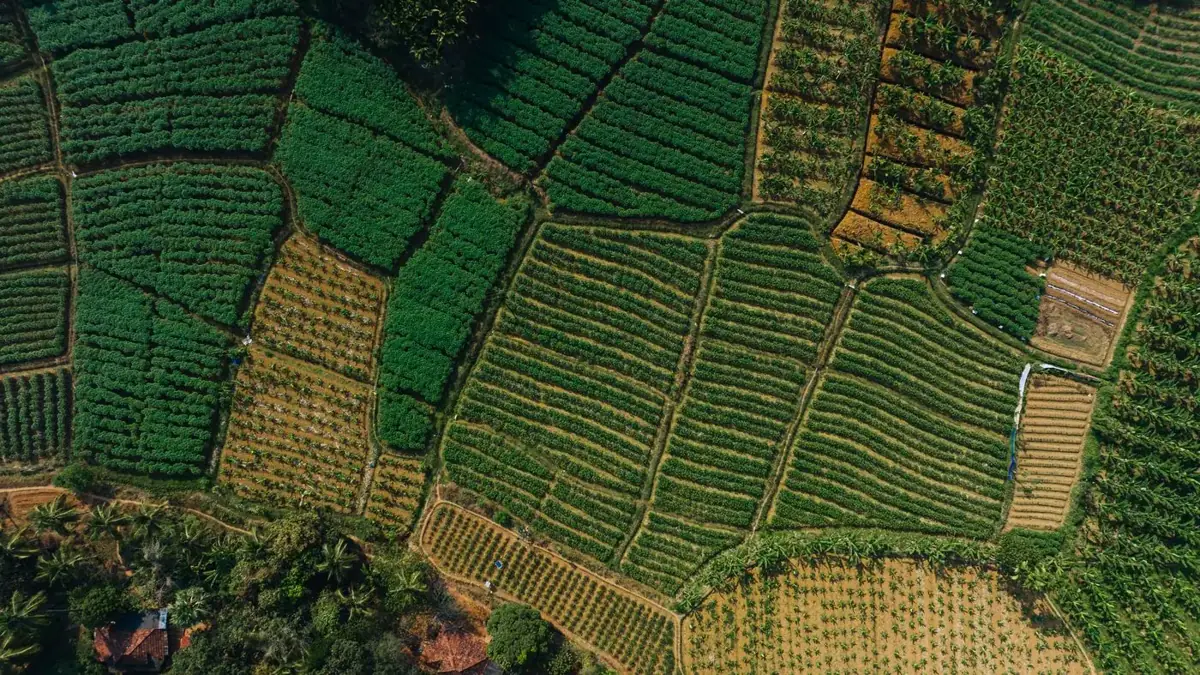 From the air
Shell and roof: months two to four
Foundation, walls and roof usually run eight to twelve weeks depending on the weather and the size of the build. Monsoon is the main variable; a July start typically loses three to four weeks.
Visit the site at least twice during this phase. Photographs are not a substitute for standing in a room and realising the window is in the wrong place.
Finishes: months four to seven
Plaster, flooring, joinery, plumbing fixtures, electricals and paint. This is where most budget overruns happen, because finishes are the easiest thing to upgrade in the moment.
Fix your finishes schedule in writing before this stage begins, and hold a contingency of around ten percent rather than spending it early.
 Paperwork
Try the numbers yourself
Value today
₹97.5 L
Projected value after 5 years
₹1.88 Cr
Potential gain of ₹90.2 L on paper.
Indicative only. Actual rates depend on the parcel, road access and paperwork status.
Landscape runs in parallel
Plant the boundary as early as the first monsoon of the build, not at the end. Trees planted in month two are established by handover; trees planted at handover are a maintenance problem for two years.
Set up drip irrigation while the ground is already dug up for services.
Handover day
A proper handover is a walk, not a key exchange: boundary confirmed, services demonstrated, snag list written and signed, warranties and drawings handed over as a set.
Keep the snag list open for a defined period after handover, with a named person responsible. Everything gets fixed faster when the list has a date on it.
 Air quality
Where projects go wrong
Three causes cover most of it: scope changes mid-build, no written bill of quantities, and multiple vendors with no one owning the timeline. A single turnkey contract removes all three.
We run construction as one contract with one project manager and one bill so there is nobody to point at but us.
Go deeper